Compound Interest Calculator
Enter a starting amount, an annual rate and a time period to see how compounding grows your balance.
How it works and known limits
The formula
The calculator uses A = P(1 + r/n)^(nt), where P is the principal, r is the annual rate as a decimal, n is the number of compounding periods per year and t is the number of years. Total interest is the final amount minus the principal. More frequent compounding produces a higher result because interest earns interest sooner.
Contribution-free projection
This tool models a single lump sum with no recurring deposits or withdrawals. It does not model tax, inflation or fees, so the result is a nominal figure. Use it to compare rates and terms rather than to predict actual purchasing power.
Known limits
The annual rate is assumed to stay constant for the whole term. Real savings and investment rates vary, and a fixed-rate projection can be misleading over long horizons. Results are rounded for display and are estimates, not financial advice.
How to calculate compound interest (with screenshots)
See how an investment grows with compound interest, with principal, rate, term and compounding frequency.
Open the Compound Interest Calculator
Open the Compound Interest Calculator page. The principal is where your work begins; the result appears on the right.
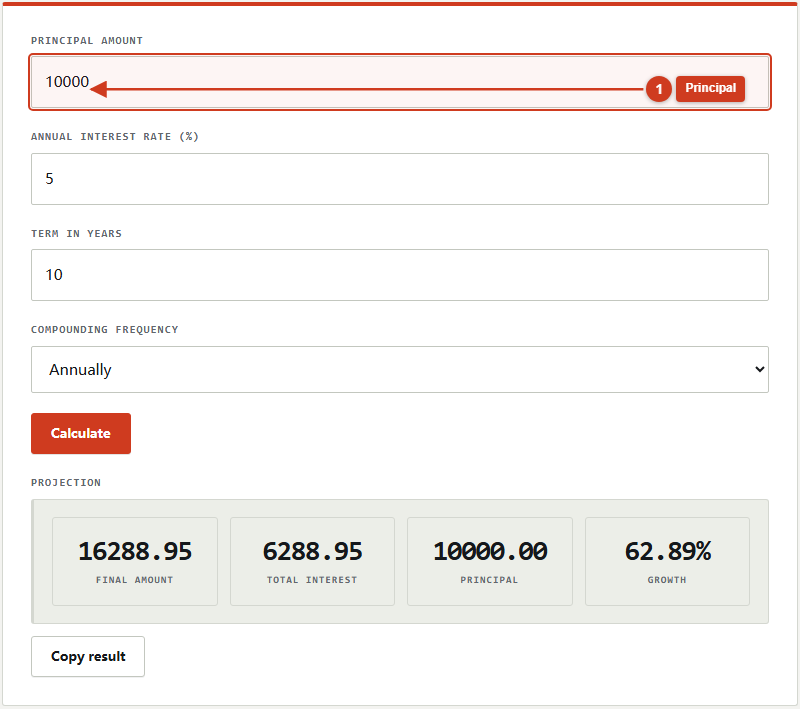
Enter your input
Enter the starting amount. This example uses 10,000. Enter the annual interest rate as a percentage, without the % sign. Enter the investment term in years.
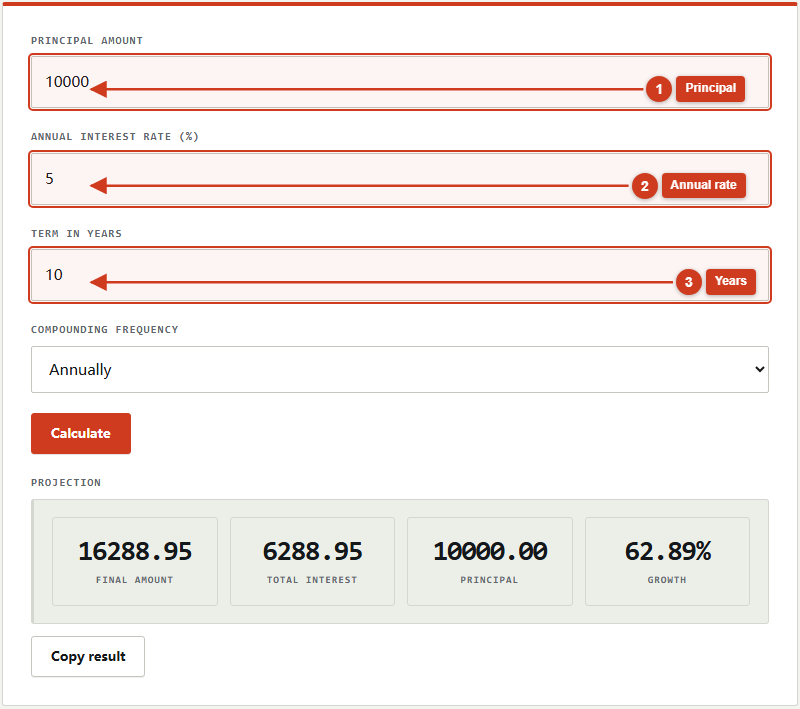
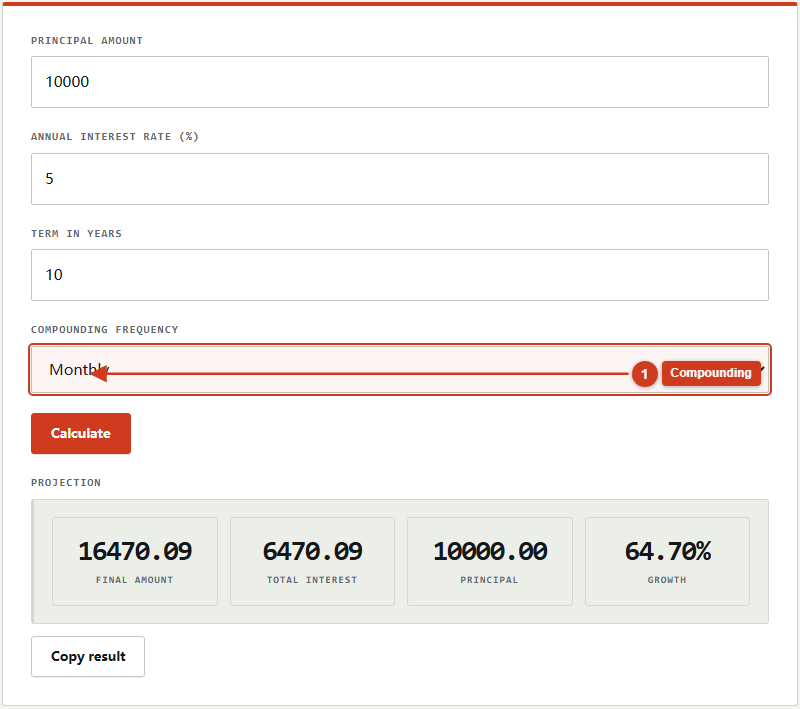
Set the options
Choose how often interest compounds. Monthly (12) is selected here.
Read the result
The result updates as you type: final amount, interest earned, original principal and overall growth percentage.
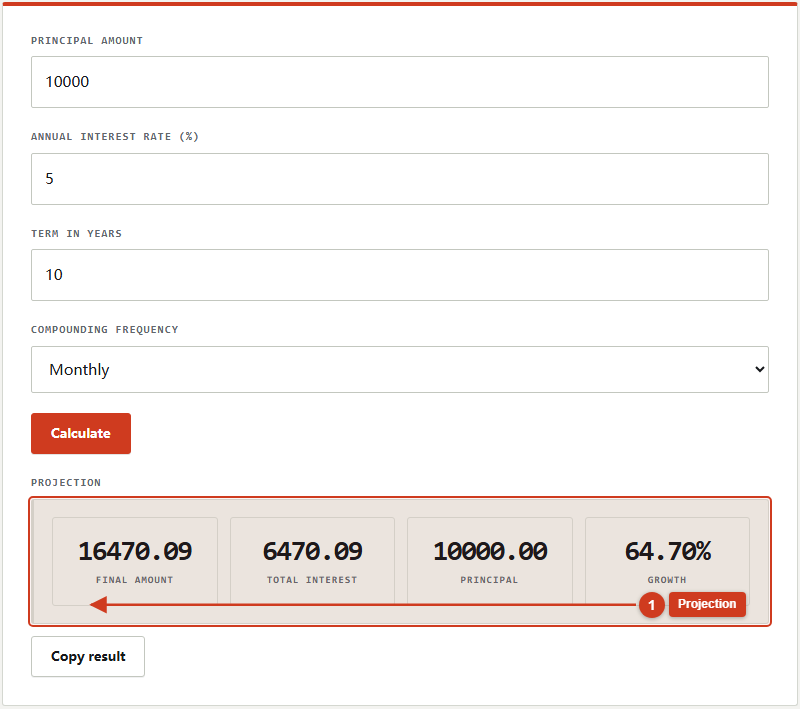
Tip: More frequent compounding produces a higher final amount for the same nominal rate.
Frequently asked questions
What compounding frequencies are available?
Annually, semi-annually, quarterly, monthly, weekly and daily.
Does it include monthly deposits?
No. This calculator models a one-time principal only, with no recurring contributions.
Is the result guaranteed?
No. It assumes a constant rate and no fees, tax or inflation. Treat it as an illustration.
Is my financial data stored?
No. All calculation happens locally in your browser.
Page last reviewed: